

By Onoja Baba, Nigeria
The office of former Attorney General of the Federation and Minister of Justice Abubakar Malami has condemned the Economic and Financial Crimes Commission for allegedly refusing to comply with a court order granting him bail, continuing his detention beyond the authorised period, and engaging in what it described as an orchestrated media campaign to prejudice public opinion.
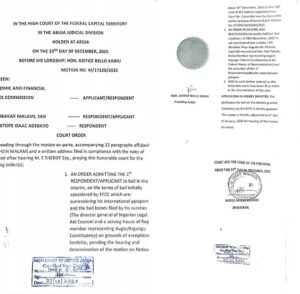
In a statement issued on December 23, Malami’s media aide Mohammed Bello Doka claimed that despite a High Court of the Federal Capital Territory admitting the senior advocate to bail on fulfilled conditions the same day, EFCC officials rejected service of the court process, chased away the bailiff, and insisted on keeping him in custody. The statement characterised this as institutional lawlessness and open contempt, arguing that the anti-graft agency had placed itself above judicial authority.
Further allegations include holding Malami for over fourteen days without arraignment before any court, in violation of constitutional rights against arbitrary detention. The statement noted that the Commission’s detention was based on a separate High Court order limited to fourteen days, which expired on December 23, obligating either his release or immediate charge—actions the EFCC reportedly failed to take.
The release accused the agency of abandoning due process in favour of a media trial, selectively leaking information to shape narratives and secure convictions through public sentiment rather than legal proceedings. It portrayed these actions as evidence of political persecution, warning that when an anti-corruption body disobeys courts and weaponises media, it poses a threat to democratic principles.
Malami’s office reiterated his willingness to face any allegations strictly through lawful judicial processes, rejecting what it termed trial by detention and vendetta. It called on the judiciary to address the alleged contempt, oversight bodies to investigate the EFCC’s conduct, and the public to resist the precedent of selective law enforcement.
The EFCC has not publicly responded to the specific claims by press time. The developments highlight ongoing tensions between high-profile figures and anti-graft institutions, raising fresh questions about adherence to rule of law in Corruption probes.
categories
recent posts
IMF Says Malawi Making Progress on Economic Recovery Reforms

NIGERIA: Makinde Campaign Sets 68m-Vote Target As APM Kicks Off 2027 Drive
NIGERIA: INEC Assures On Election Integrity As 2027 Polls Enter Final 100-Day Countdown

Messi Ends Argentina Career on a High