
By Deborah Akur Chol, South Sudan
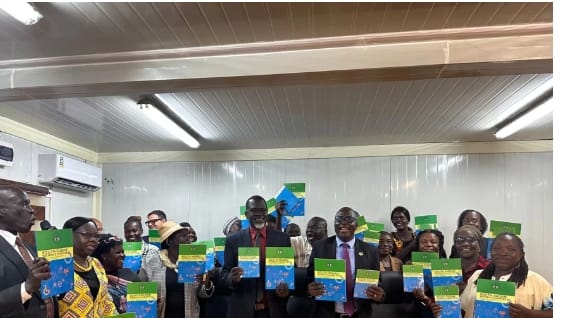
The National Constitutional Review Commission (NCRC) has officially received the South Sudan Women’s Charter, marking a significant achievement for women’s representation in the nation’s constitution-making process.
Dr. Riang Yer Zuor, Chairperson of the NCRC, highlighted the importance of this submission, explaining how the Charter contributes to the overall framework for drafting the permanent constitution.
“In line with section 12, subsection 6 of the act, the Women’s Charter is being submitted to the NCRC as a representation of women’s positions on issues that are crucial to them and, by extension, to the entire country,” Dr. Yer stated.
He emphasised that the constitution-making process is intended to be citizen-driven, urging active participation from all South Sudanese throughout every stage. Dr. Yer underscored that civic education and public consultations are vital for ensuring meaningful involvement.
“It is essential to educate the people of South Sudan about this process, helping them understand the roles they are expected to play, as this endeavour should be led and owned by the citizens themselves,” he remarked.
At the event, James Francis, Undersecretary in the Ministry of Parliamentary Affairs, noted that the Women’s Charter encompasses a wide range of women’s needs and priorities.
“The Charter addresses 12 key thematic areas, including political participation, health education, economic empowerment, protection against violence, and climate security. This broad scope reflects the diverse needs of women and girls in South Sudan,” Francis explained.
He further asserted that the Charter is more than just a document; it serves as a vital instrument for ensuring that women’s rights and gender equality are integral to the nation’s legal framework.
“The Charter is a crucial tool for incorporating women’s rights and gender equality principles into South Sudan’s permanent constitution. This moment represents a pivotal opportunity for all South Sudanese to ensure that the voices of citizens, particularly women, are included in this foundational document,” he added.
The submission of the Charter symbolises a united effort by women, civil society organisations, government institutions, and development partners to ensure that women play a central role in the governance, development, and peace-building initiativ
es within the country.
categories
recent posts
IMF Says Malawi Making Progress on Economic Recovery Reforms

NIGERIA: Makinde Campaign Sets 68m-Vote Target As APM Kicks Off 2027 Drive
NIGERIA: INEC Assures On Election Integrity As 2027 Polls Enter Final 100-Day Countdown

Messi Ends Argentina Career on a High