By Onoja Baba, Nigeria
Some prominent Nigerian lawyers have reacted to the
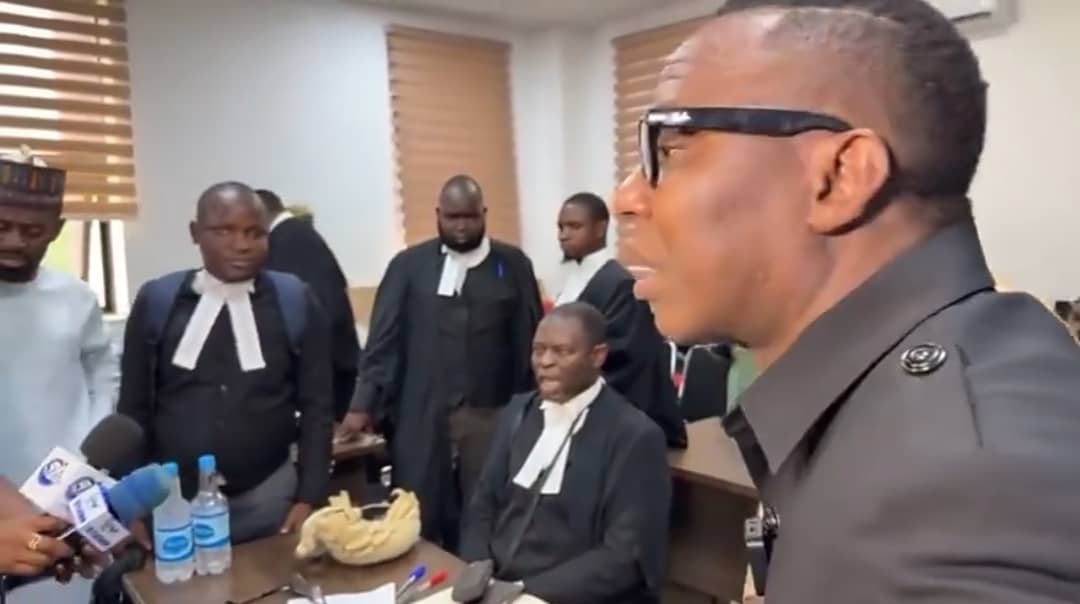
dramatic confrontation between activist Omoyele Sowore and a Senior Advocate of Nigeria (SAN), inside the Federal High Court, Abuja on Tuesday.
The confrontation has ignited strong disagreement among lawyers on whether or not it is lawful to hold press briefings in a courtroom while awaiting judicial proceedings.
The clash occurred when Sowore attempted to address journalists inside the courtroom. In a widely circulated video, the SAN confronted him, insisting the courtroom was not an appropriate venue for a press briefing.
However, Sowore fired back, saying: “you’re intimidating me and insulting my intelligence because you’re introducing yourself to me as a SAN. I also have my own SANs.”
He insisted that no law prohibits addressing the media inside the courtroom.
Meanwhile, the SAN rejected Sowore’s position, declaring: “I have practised for close to three decades and have never seen this happen… The court must serve as a venue of justice, not a conference.”
The SAN urged the journalists to move the interview outside the court premises.
Reacting to this, some legal practitioners who spoke to African Culture TV expressed sharply divided views.
A Senior Partner at R. R. Adejo-Andrew and Co., Salifu Oguche Usman, Esq. (LL.M) acknowledged that while the law is silent on granting press conferences after proceedings, the judiciary and senior bar have consistently condemned such practices.
“The court and the upper echelon of the bar have consistently labelled such as media trial and condemned same as excessive exposure of the judiciary. A balance of fair reportage of proceedings has to be struck,” he said.
Lynda Akawo, Esq., argued strongly against conducting press briefings inside the courtroom.
She noted that “holding a press briefing inside a courtroom is generally not legally permitted without the express permission of the presiding judge. It’s often considered a violation of court decorum, sub judice rules, and contempt of court… While the press has a constitutional right to cover court proceedings, this right does not and cannot in any way extend to disrupting proceedings or conducting public meetings within the courtroom itself.”
In contrast, Dr. I.B. Ahmad, Esq., defended Sowore’s action, stating that the briefing was lawful because the court was not yet sitting.
He said, “What is not permitted is carrying on a press function while the Court is sitting. As long as the Court is not sitting, a press briefing can be conducted anywhere anytime. The Press Briefing by Sowore was, therefore, not legally wrong in the light of the fact that the Court was not sitting yet.”
Meanwhile, Head of Chambers at Prime Law Firm, Abuja, Stephen O. Atabor, Esq., took an even stronger position in support of Sowore. He rooted his argument in constitutional provisions.
“There’s no restrictions as to where an interview by the press can be conducted… The right of press is a constitutional right provided under Section 39 (1) of the 1999 constitution… So therefore, the SAN cannot restrict anybody from exercising that right,” Atabo said.
He further explained that “Section 39(1) of the 1999 constitution is not a blanket right. It must be utilized or invoked in such a way that it will not offend public safety, order, morality and health… In the instant case, was the press interview granted by Sowore injurious or offend public safety and order? And if it does, it is the court that has the vires or power to declare so and not the SAN. I think to my mind, the SAN has gone overboard his legal responsibility to restrict interviews in the court, which is a public place.”
The incident has once again highlighted the ongoing tension between the constitutional right to freedom of expression and the need to maintain courtroom decorum and judicial integrity in Nigeria.
As of press time, neither the Federal High Court nor the Nigerian Bar Association had issued
an official statement on the matter.
categories
recent posts
IMF Says Malawi Making Progress on Economic Recovery Reforms
NIGERIA: Makinde Campaign Sets 68m-Vote Target As APM Kicks Off 2027 Drive
NIGERIA: INEC Assures On Election Integrity As 2027 Polls Enter Final 100-Day Countdown

Messi Ends Argentina Career on a High