By Onoja Baba
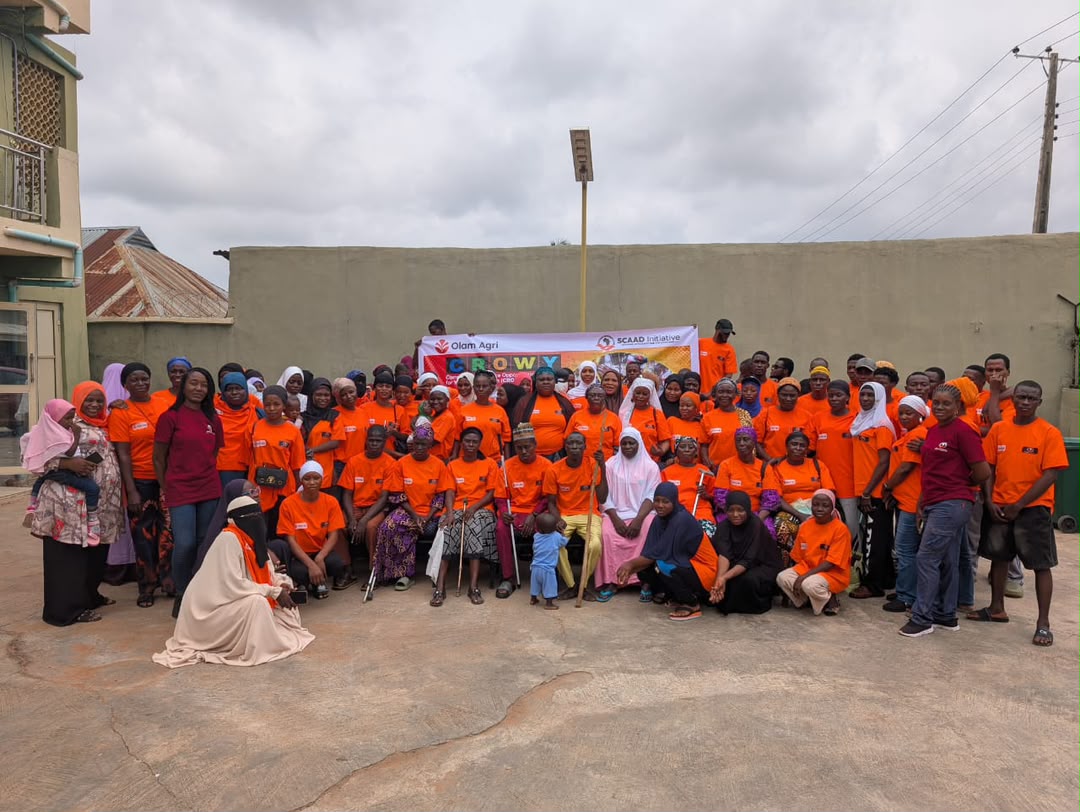
Olam Agri, a global food, feed and fibre agribusiness with extensive operations across agricultural value chains, and the Sustainable Collective Advocacy for Africa Development (SCAAD) Initiative have expanded their Community Resilience Opportunities for Women and Youth (CROWY) Project to Kwara State, in a move aimed at equipping vulnerable women and young people with practical skills, enterprise support and livelihood opportunities.
The expansion, announced in Ilorin last week, comes after what the organisations described as encouraging results from the first phase of the programme in Nasarawa and Benue states, where 100 women and youths received hands-on vocational training and starter support between December 2025 and March 2026.
The initiative is coming against the backdrop of persistent livelihood and employment challenges confronting Nigerians. The World Bank says Nigeria faces the challenge of absorbing about 3.5 million new entrants into the labour force every year, amid weak job creation and limited entrepreneurial opportunities. It has also stressed the need for productive jobs and stronger support for farm and non-farm household enterprises.
Women remain particularly exposed to precarious livelihoods. World Bank data based on ILO estimates show that 79.1 per cent of employed Nigerian women were in vulnerable employment in 2025, compared with 54.8 per cent of men.
The poverty challenge is also significant in Kwara. The National Bureau of Statistics’ 2022 Multidimensional Poverty Index put the state’s multidimensional poverty incidence at 10.2 per cent, while the national survey found that 63 per cent of Nigerians were multidimensionally poor, with rural communities recording significantly higher deprivation than urban areas.
Against this background, CROWY is designed to provide women and young people, particularly farmers and members of vulnerable communities, with alternative sources of income during periods when agricultural activities decline and household earnings become more uncertain.
During the first phase, beneficiaries were trained in six market-oriented trades: soap making, hairdressing, shoemaking, carpentry, tailoring and welding. Each participant received certification, a trade-specific starter kit and additional training in business management, financial literacy and savings.
According to the organisations, the programme recorded a 100 per cent completion rate among the 100 beneficiaries in Nasarawa and Benue.
The impact, they said, was already becoming visible beyond the classroom.
In Benue, beneficiaries trained in shoemaking reportedly progressed from apprentices to independent producers within weeks, with handmade shoes selling for between ₦20,000 and ₦27,000 per pair. In Nasarawa, a soap-making graduate expanded into producing laundry soap, while a welding graduate secured a contract to manufacture doors for a private company shortly after completing the training.
The organisations said an independent evaluation is being prepared to assess the longer-term impact of the first phase, including changes in beneficiaries’ incomes, businesses and livelihoods.
Speaking on the expansion, Country Head of Olam Agri in Nigeria, Anil Nair, said the experience in Nasarawa and Benue had demonstrated the potential of targeted skills development to create pathways to economic independence.
“The success and impact of this project shows that through targeted support and partnership, women and youth are able to develop foundational skills that enable them to earn a living, gain economic independence and improve their livelihoods,” Nair said.
He added that the expansion would enable the partners to reach more people in Kwara and help strengthen local communities through practical economic opportunities.
For SCAAD Executive Director, Frances Okeke, the project was designed to respond to the gap between the resilience of grassroots communities and the limited resources available to turn that resilience into sustainable livelihoods.
“Every day, we meet women and young people with immense creativity and resilience, yet without the support they need to thrive,” Okeke said.
She said economic pressures were particularly severe in farming communities during non-farming seasons, adding that the new phase would combine skills development with entrepreneurship, leadership and awareness around gender equality and Gender-Based Violence.
“With support from Olam Agri, the CROWY SOY Project is stepping into this gap, offering practical skills, livelihood opportunities, and hope to grassroots women and youth,” she said.
Beyond vocational training, the Kwara phase will focus on strategic leadership, entrepreneurship, inclusive economic participation and financial empowerment. Participants will also receive education on gender equality and how to recognise early warning signs and appropriate responses to Gender-Based Violence.
The programme will seek to strengthen access to cooperative financing and support the emergence of women and youth-led enterprises, with the broader objective of encouraging self-employment and creating more resilient household incomes.
The approach reflects growing evidence that skills training produces stronger results when combined with access to finance, savings mechanisms, markets and business support. The World Bank’s Nigeria for Women Project, for instance, supported more than one million people between 2018 and 2024 and helped 458,208 women through 22,094 Women Affinity Groups, which provided platforms for savings, loans, training and economic activities.
The World Bank has also warned that simply increasing the number of people working will not automatically reduce poverty, noting that Nigeria needs more productive employment and stronger productivity in both agricultural and non-agricultural household enterprises.
For Olam Agri and SCAAD, the Kwara expansion therefore represents more than another skills-acquisition programme. The partners say they intend to use the CROWY model to help women and young people move from seasonal economic vulnerability towards sustainable livelihoods, stronger enterprises and greater participation in their communities.
The CROWY partnership with SCAAD began with the launch of the first phase in Nasarawa and Benue in December 2025, with the programme targeting women and youth in communities where limited economic opportunities can heighten vulnerability during off-farm periods.
The partners said they would continue to pursue a catalytic model that combines skills, enterprise development, financial inclusion and community resilience, with the ultimate aim of enabling beneficiaries not only to earn incomes but also to create opportunities for others within their communities.
categories
recent posts
NIGERIA: Olam Agri, SCAAD Expand Women, Youth Empowerment Project To Kwara
Kenya Confirms First Imported Ebola Case, Patient Dies
NIGERIA: Appeal Court Reserves Judgment On El-Rufai’s Bail Application

Tumaini Festival Cancelled for the First Time