By Deborah Akur Chol, South Sudan
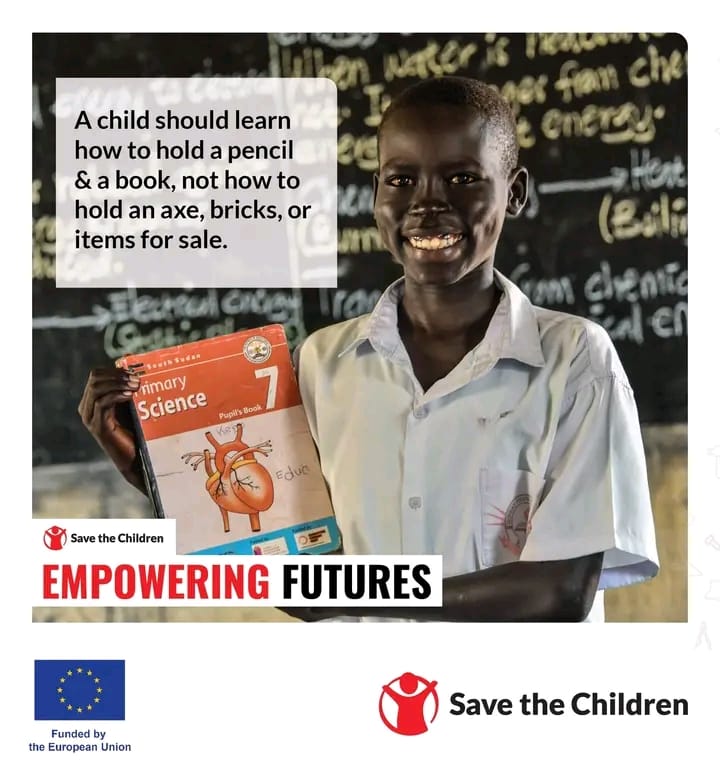
A recent report by Save the Children organisation has revealed that nearly two-thirds of children surveyed in South Sudan, aged between 5 and 17 years, are engaged in severe forms of child labour. In some of the most affected regions, the rates soar to a staggering 90 per cent, according to findings from the Ministry of Labour, Ministry of Gender, Child and Social Welfare, and Save the Children.
As detailed in a press statement provided to this publication by Save the Children, the comprehensive National Child Labour Study surveyed over 418 households across seven states in South Sudan. The study uncovered that 64 percent of the children included in the survey are involved in the worst forms of child labour, which encompass forced labour, sexual exploitation, and participation in illicit activities such as theft, drug abuse, and armed conflict.
“In several areas, the survey indicated that almost all children are engaged in child labour. In Kapoeta South, for instance, 90 percent of children were found to be involved in various forms of labour, including gold mining, pastoralism, and agriculture, which prevent them from attending school and compel them to work to support their families,” the statement highlighted. “Additionally, local conflict and child marriages are contributing to the alarming rates of child labour in the Yambio region, where 90 percent of surveyed children were reported to be involved.”
The report outlines a troubling trend where children often transition from ‘light’ to hazardous or coercive work, ultimately becoming trapped in the worst forms of labour, which isolates them from their families and exposes them to serious risks and health issues, as explained by Save the Children.
Approximately 10 percent of children surveyed reported experiences tied to conflict-related involvement with armed groups, particularly in the counties of Akobo, Bentiu, and Kapoeta South. The activities reported by children ranged from livestock herding and farming to gold mining, brickmaking, street vending, and combat with armed factions.
The report notes a gender disparity, with boys more frequently exposed to hazardous and military-related labour, while girls are at a higher risk of domestic work, child marriage, and exploitation. Alarmingly, over 70 percent of children engaged in hazardous work come from households where caregivers are aware of child labour laws, indicating that awareness does not equate to protection.
“Furthermore, children reported broad ignorance regarding existing protection services, with only 33 percent aware of any support available in their areas, highlighting significant service gaps and fragmented referral systems,” the statement indicated. “These findings emerge amidst a backdrop of widespread food shortages in South Sudan, affecting 7.7 million people roughly 57 percent of the population and endangering 2.3 million children under five with acute malnutrition.”
“No child should be forced to work instead of learning. Child labour deprives them of their basic rights to education and the opportunity for a better future,” stated Anthony, a 16-year-old Child Representative in South Sudan. “We must unite in saying no to child labour and safeguard every child’s right to grow, learn, and succeed. Every child in South Sudan deserves the chance to dream and achieve their potential.”
During the report’s launch in Juba, Deng Tong, Undersecretary of the Ministry of Labour, emphasised the importance of the national study as a vital foundation for action.
“We must leverage this evidence to establish a national child labour database for ongoing monitoring and informed decision-making,” he stated. “The Ministry of Labour is committed to protecting our children nationwide by raising awareness that child labour is unacceptable and that education is a fundamental right for all children. We must transition from commitment to action, from promises to protection, and from rhetoric to tangible results.”
“Together, we can eradicate child labour and provide every child in South Sudan with the opportunity to dream and prosper,” Tong affirmed.
Public Service Minister Dak Duop Bichiok, who represented the Minister of Labour, acknowledged that the study provides essential evidence for policy reforms.
“This research equips us with the necessary data to reform existing policies, enhance protection systems, and ensure that every child in South Sudan enjoys their rights to education, safety, and a childhood free from exploitation,” he remarked.
Chris Nyamandi, Save the Children’s South Sudan Country Director, concluded that the engagement of nearly two-thirds of a nation’s children in work, with some regions seeing almost universal participation, signals a crisis that transcends mere poverty.
“Education is the strongest safeguard, as children who are in school are significantly less likely to engage in exploitative labour. This underscores the critical value of education in South Sudan,” he noted. “Moreover, children from food-secure households and educated caregivers are at a substantially lower risk, highlighting the connection between poverty alleviation and child protection.”
“If we, education, rebuild livelihoods, and focus on child protection, we can reverse this troubling trend. Every child deserves the opportunity to learn and thrive, not to work merely to survive,” Nyamandi asserted.
Barbara Egger, European Union Representative, echoed the sentiment, advocating for the right of every child to learn, grow, and become future leaders.
“The European Union proudly supports the children of South Sudan, along with the government and our partners, such as Save the Children, in closing legal and policy gaps, enhancing education and social protection, and ensuring no child is left behind,” she affirmed. “Together, we are transforming commitments into concrete actions, so that every child in South Sudan can realise the future they rightfully deserve.”
categories
recent posts
IMF Says Malawi Making Progress on Economic Recovery Reforms
NIGERIA: Makinde Campaign Sets 68m-Vote Target As APM Kicks Off 2027 Drive

NIGERIA: INEC Assures On Election Integrity As 2027 Polls Enter Final 100-Day Countdown
Messi Ends Argentina Career on a High