
By Onoja Baba, Nigeria
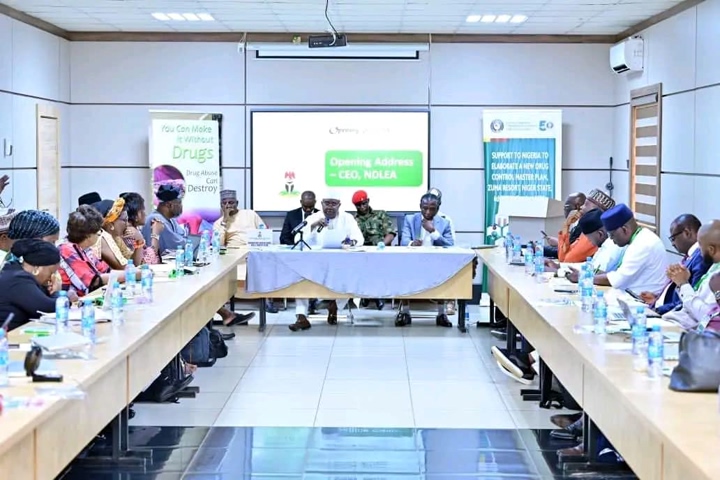
Chairman and Chief Executive Officer of the National Drug Law Enforcement Agency (NDLEA), Brigadier General Mohamed Buba Marwa (Rtd), has called on stakeholders working on Nigeria’s next National Drug Control Master Plan (NDCMP 2026–2030).
He said this is to ensure that it addresses new and evolving challenges fueling the illicit drug trade in the country.
Marwa made the call on Monday, October 6, 2025, in Niger State during the opening session of a five-day workshop organised to develop the fifth edition of the National Drug Control Master Plan.
As contained in a statement issued by Femi Babafemi, Director of Media and Advocacy, on the event, the residential retreat, funded by the ECOWAS Commission and supported by the United Nations Office on Drugs and Crime (UNODC), brought together experts and representatives of key government agencies.
According to the NDLEA boss, the forthcoming plan must be “visionary yet practical, comprehensive yet targeted, and nationally owned yet regionally and globally aligned.” He emphasised that the strategy should confront emerging threats such as synthetic drugs, dark-web trafficking, poly-substance abuse, and illicit financial flows.
“The drug problem continues to evolve, and so must our response. The NDCMP 2026–2030 must build on past achievements while boldly addressing new realities. This workshop provides us the opportunity to identify what has worked, acknowledge the gaps, and design innovative pathways for the future,” Marwa said.
He stressed that the master plan was not just another document, but a roadmap to safeguard the health, security, and well-being of Nigerians. He also reaffirmed NDLEA’s commitment to providing leadership, coordination, and technical support for the plan’s successful implementation.
“We will continue to strengthen collaboration with our partners within Nigeria and across the ECOWAS sub-region. The drug challenge recognises no borders,” Marwa added, while appreciating ECOWAS, the European Union, UNODC, civil society organisations, and private sector partners for their continued collaboration.
Speaking at the event, UNODC Country Representative, Cheikh Ousmane, represented by Dr Akanidomo Ibanga, commended Nigeria’s ongoing anti-drug efforts but noted that the nation must remain adaptive and coordinated in its response.
“The Master Plan is the instrument through which we can harmonise national realities with international standards, including the three international drug control conventions, the 2030 Agenda for Sustainable Development, and the African Union Plan of Action on Drug Control,” he stated.
Also, the ECOWAS Commissioner for Human Development and Social Affairs, Prof. Fatou Sow Sarr, represented by Dr Daniel Amankwaah, said the Commission’s technical and financial support was aimed at helping Nigeria design a robust and evidence-based national strategy.
“The ECOWAS Commission remains committed to supporting Nigeria in ensuring that the new National Drug Control Master Plan effectively addresses current and future drug-related challenges,” she said.
Other agencies represented at the workshop included the Federal Ministries of Education, Health, Agriculture, Budget and Planning, as well as NACA, NAFDAC, EFCC, and the NFIU.
categories
recent posts
IMF Says Malawi Making Progress on Economic Recovery Reforms
NIGERIA: Makinde Campaign Sets 68m-Vote Target As APM Kicks Off 2027 Drive
NIGERIA: INEC Assures On Election Integrity As 2027 Polls Enter Final 100-Day Countdown

Messi Ends Argentina Career on a High