
By Ameenat Hamzat, Lagos, Nigeria
The Federal Government of Nigeria has successfully raised ₦501 billion through its inaugural bond issuance under the Presidential Power Sector Debt Reduction Programme (PPSDRP), recording 100 per cent subscription from pension funds, banks, asset managers and other institutional investors.
The bond issuance represents a major intervention aimed at resolving long-standing payment arrears owed to power generation companies, restoring liquidity, and strengthening confidence across the Nigerian Electricity Supply Industry.
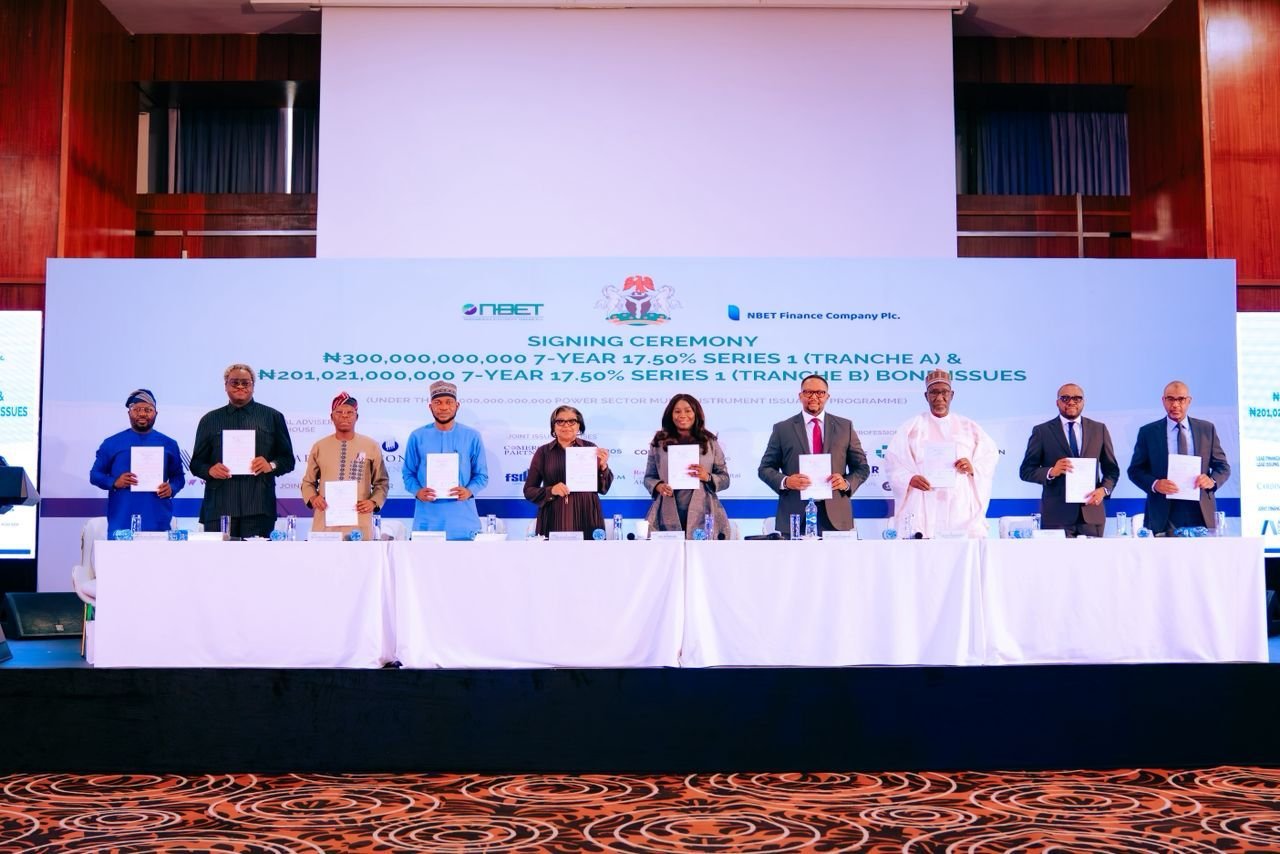
The signing ceremony for the Series 1 Power Sector Bond was held in Lagos on January 27, 2026, following the completion of the issuance by NBET Finance Company Plc.
The Programme, championed by President Bola Ahmed Tinubu, is designed to address legacy debts that have constrained liquidity, weakened balance sheets and discouraged investment across the power sector value chain for more than a decade.
The Series 1 issuance closed at ₦501 billion, comprising ₦300 billion raised from the capital markets and ₦201 billion in bonds allotted to participating power generation companies, reflecting strong investor confidence in the government’s reform agenda.
Under the Programme, verified receivables for electricity supplied between February 2015 and March 2025 are being settled through negotiated agreements with power generation companies. Five-generation companies operating fourteen power plants nationwide have executed settlement agreements with the Nigerian Bulk Electricity Trading Plc, with a total negotiated settlement amount of ₦827.16 billion to be paid in four phased instalments.
Proceeds from the bond issuance will fund the first and second instalment payments to participating power generation companies, estimated at ₦421.42 billion, representing approximately 50 per cent of the total negotiated settlement amount. Payments for the initial phase will be made through a mix of cash and notes.
Speaking at the signing ceremony, the Special Adviser to the President on Energy, Olu Arowolo Verheijen, described the Programme as a decisive reset of the electricity market.
He said: “The Programme represents a decisive reset of the electricity market, combining debt resolution with broader financial and structural reforms.”
Verheijen further mentioned that Industry stakeholders said the bond issuance has restored confidence in the sector and is expected to unlock fresh investments.
He said: “Capital formation can only come when there is confidence, when you can truly see a line of sight in recovering investments previously made. Because we were being owed so much, it was a bit of a problem for us to put in more money.”
“But last year we took the bull by the horns, based on President Bola Ahmed Tinubu’s commitment to resolving the legacy issues. Once this process is over, construction will commence immediately on the second phase of our Egbin Power Plant.”
By clearing historic arrears, the Programme is expected to improve liquidity for power generation companies, strengthen their capacity to meet operating and debt obligations, and support a more reliable electricity supply for homes and businesses.
When completed, the Programme is projected to impact 4,483.60 megawatts of electricity generation capacity and finalise settlement for 290,644.84 gigawatt-hours of electricity billed since 2015, providing a strong foundation for capacity expansion serving over 12 million registered electricity customers nationwide.
Reaffirming the Federal Government’s position, Verheijen said implementation would remain disciplined and transparent.
“The Federal Government reaffirms its commitment to disciplined implementation of the Programme. We look forward to the participation of other power generation companies, as part of our broader reforms aimed at building a financially sustainable electricity market that is capable of supporting Nige
ria’s long-term economic growth.”
categories
recent posts

NIGERIA: FG Moves To Unlock 1,600MW Stranded Power With New Grid Company Plan

NIGERIA: Frank Mba, Seven DIGs Retire as PSC Promotes Replacements