
By Onoja Baba
President Bola Ahmed Tinubu on Tuesday took a major step towards the establishment of state police in Nigeria by inaugurating a Presidential Working Group to draft the National Policing Bill, the legislation that will provide the legal framework for implementing the country’s proposed dual policing system.
The inauguration, held at the Presidential Villa, Abuja, signals the Federal Government’s determination to fast-track the operationalisation of state police even before the constitutional amendment process is completed.
Represented by his Chief of Staff, Femi Gbajabiamila, the President said the National Assembly had already passed the Constitution Alteration (State Police) Bill, 2026, which proposes a dual policing structure comprising the Federal Police Service and 36 State Police Services.
Tinubu explained that while the constitutional amendment establishes the legal foundation for state police, the National Policing Bill will provide the operational framework required for its implementation.
“The Constitution Amendment Bill establishes the framework for dual policing, but it does not operationalise it. That work is left to the National Policing Bill,” the President said.
According to him, the proposed legislation will contain provisions on minimum policing standards, state readiness certification, federal and state coordination, accountability mechanisms, human rights safeguards and fiscal requirements for the establishment and operation of state police.
He said the committee had been constituted to produce a technically sound and implementation-ready draft bill for transmission to the National Assembly immediately after the constitutional amendment process is concluded.
“We must not wait until the constitutional process is concluded before beginning this important assignment,” Tinubu added.
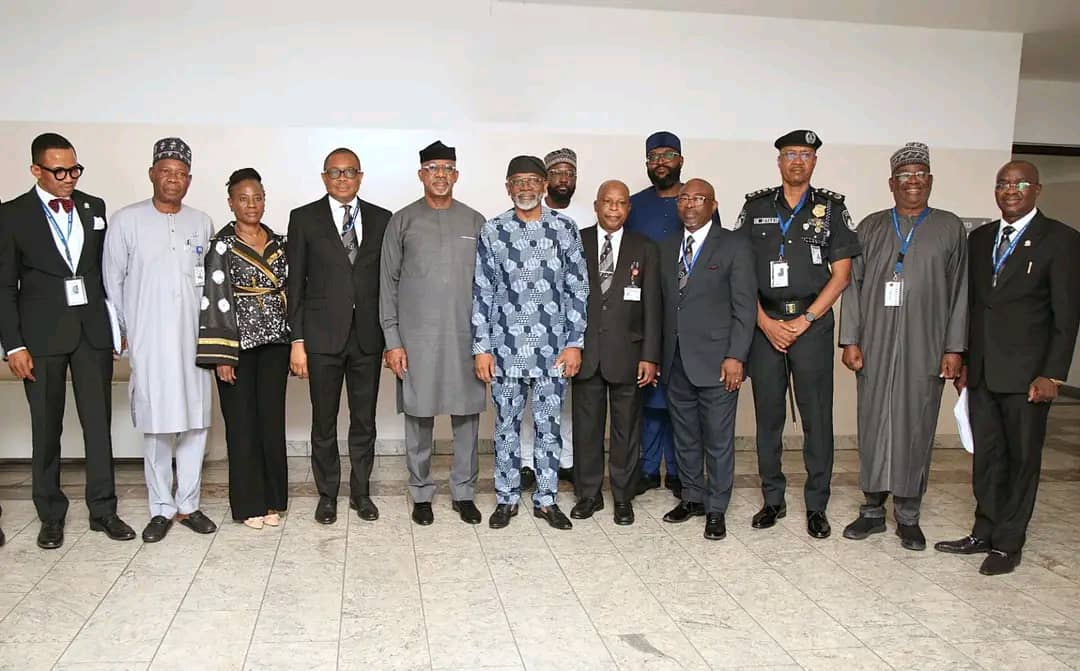
The committee is chaired by Gbajabiamila and comprises the Attorney-General of the Federation and Minister of Justice, Lateef Fagbemi (SAN), the President of the Nigerian Bar Association, Afam Osigwe, the Chairman of the Nigeria Governors’ Forum, Governor AbdulRahman AbdulRazaq, the National Security Adviser, the Inspector-General of Police, and the Chairman of the Nigeria Governors’ Forum Committee on State Police. A secretariat will provide administrative support to the panel.
Speaking on behalf of the Nigeria Governors’ Forum, Ogun State Governor Dapo Abiodun pledged the support of the nation’s governors for the speedy implementation of the state police initiative.
He disclosed that governors would work to ensure the constitutional amendment is quickly ratified by their respective State Houses of Assembly once transmitted.
Abiodun described state police as a response to Nigerians’ long-standing demand for community-based policing and noted that regional security outfits such as Amotekun had demonstrated the effectiveness of decentralised security structures.
He projected that if each of the 36 states recruits about 6,000 police personnel, Nigeria would gain nearly 200,000 additional officers to complement the existing Federal Police Force.
“This bill has answered the cries of Nigerians about cascading policing and removing it from the Exclusive Legislative List,” the governor said.
Attorney-General of the Federation, Lateef Fagbemi, described the initiative as timely in view of the country’s growing security challenges.
“There is no denying the fact that we are in a critical moment security-wise, and all hands must be on deck,” he said, while urging governors to facilitate the early passage of the constitutional amendment in their various state assemblies.
Also speaking, Nigerian Bar Association President Afam Osigwe reaffirmed the association’s support for the establishment of state police, saying Nigeria could no longer be effectively policed through a single national police structure.
He, however, cautioned against possible abuse of state police powers, stressing that the legislation must include adequate safeguards to guarantee accountability, protect human rights and prevent political oppression.
“We must ensure we do not create a monster. The right legal framework must guarantee accountability and prevent oppression,” Osigwe said.
Other dignitaries at the inauguration included Attorneys-General and Commissioners for Justice from Plateau, Lagos and Ondo states, representatives of the Inspector-General of Police and the National Security Adviser, as well as other senior government officials.
categories
recent posts
IMF Says Malawi Making Progress on Economic Recovery Reforms
NIGERIA: Makinde Campaign Sets 68m-Vote Target As APM Kicks Off 2027 Drive
NIGERIA: INEC Assures On Election Integrity As 2027 Polls Enter Final 100-Day Countdown

Messi Ends Argentina Career on a High